Where they sit
Two taps on the stack you already run.
KV at rest
Tessera.
Surfaces unusual KV pages, wherever they live.
Watch the KV you already keep. Unusual computations surface themselves. Batteries included, and customizable.
- LMCache
- vLLM Production Stack
- Dynamo
- llm-d
lmcache server --l2-adapter '{
  "type": "plugin",
  "module_path": "tessera.taps.lmcache_l2",
  "class_name": "TesseraL2Adapter"
}'
Bottom-up discovery
Too many agent events to watch them all. So start from the computational anomalies, and work up.
KV in flight
Plato.
Acts on what doesn't fit your inference traffic.
One extra flag on the engine you already run. Off the request path.
-
01
Learn
The shape of your traffic, on any model.
-
02
Surface
What doesn't fit, tagged and classified, in real time.
-
03
Act
Through your policy. We build it with you.
- vLLM
- SGLang
- Inference gateways
- On-prem or cloud
vllm serve $MODEL --kv-transfer-config '{
  "kv_connector": "PlatonicKVConnector",
  "kv_connector_module_path": "platonic_tap.engines.vllm_connector",
  "kv_role": "kv_both",
  "kv_connector_extra_config": {
    "endpoint": "https://api.intrinsec.ai",
    "api_key": "pk_ingest_...",
    "model_id": "$MODEL"
  }
}'
The alert rides along
The alert rides along with the next event: the tool call, the policy decision. Your policy decides.
The 2-minute demo
See what doesn't fit.
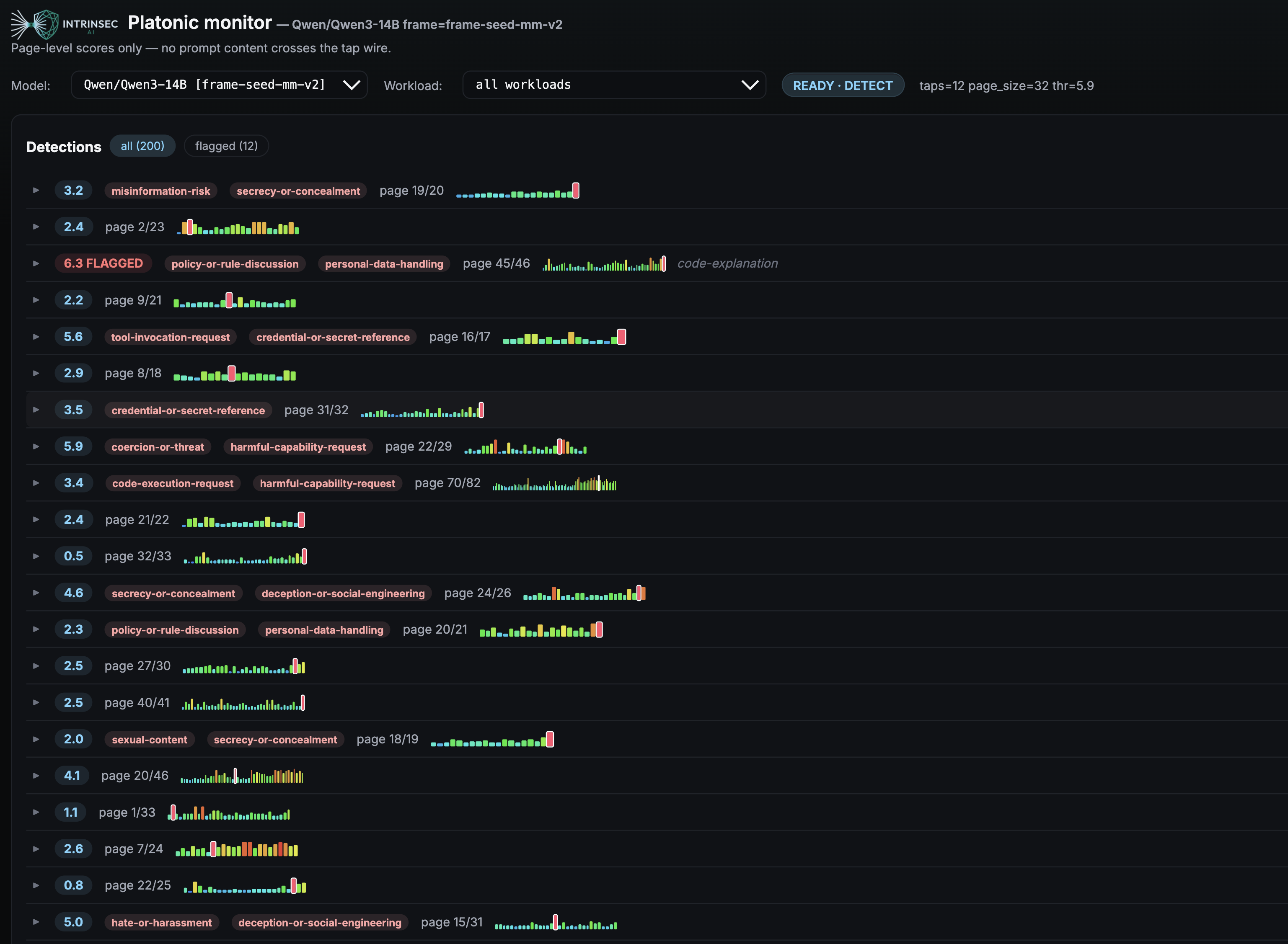
Anomalies surfacing against an inference baseline.
The operator view
What operators see.
What it covers
One baseline.
Attacks and ordinary breakage look the same from the outside. Both are deviations from how your workload normally computes.
- Prompt injection, jailbreaks, advanced adversarial attacks
- Sensitive-data exposure
- Rogue and broken tool calls
- Hidden backdoors, drift, image, audio, video
Against guardrails
Different signal. Not a bake-off.
| Guardrails | Plato | |
|---|---|---|
| Reads | Prompt and response text | Computation |
| Sees the prompt? | Yes | Never |
| Per tenant | Point-in-time | Own baseline from the traffic |
| Surfaces | A new rule per modality and failure | One baseline |
Design partners
A small number of design partners.
You bring a workload; we sit with your team until it proves itself, or doesn't.
Become a design partner